About the artist
Ignacio Poblet
A Peruvian visual artist, born in Lima in 1975 and based in Colombia, whose work engages Andean memory and contemporary symbolism.
Biography
Between ancestral memory and contemporary life
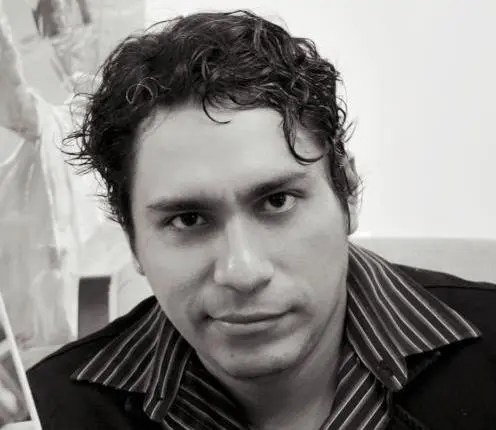
Ignacio Poblet is a Peruvian visual artist born in Lima in 1975 and based in Colombia. Trained at the National School of Fine Arts in Lima, he belongs to its 1997 graduating cohort. His painting brings cultural memory, urban experience and contemporary symbols into dialogue.
His exhibition history reaches back to Lima in 1997 and Miami in 2007, followed by Cali in 2010, Cusco in 2012, BINARTECO in Lima in 2014, public exhibition and speaking activity in Palmira in 2015, ArtCali in 2015 and 2016, a collective exhibition at Galería Delbarrio in Lima in 2016, Singapore Contemporary in 2017, Sala Limaq in Lima in 2024, and the Embassy of Peru in Berlin in 2025.
Across these projects, recurring concerns include the construction of cultural identity, the pressure of contemporary urban life and the coexistence of Andean and Western symbols. Wandering Deities in Berlin made that dialogue explicit, presenting his work through the lens of identity in a fragmented, globalized present.
Artist-authored practice
Language, territory, biodiversity and transformation.
This section is based on the professional portfolio supplied directly by Ignacio Poblet in October 2026 and has been edited for clarity without changing the artist’s stated ideas.
Ecosystem and biodiversity
Painting in front of an ecological sanctuary has made it impossible for Poblet to ignore the life around him. He describes becoming emotionally and humanly involved with the surrounding ecosystem, and says the stories of the animals themselves can be as compelling as the paintings they inspire. Biodiversity has become a recurring subject in recent years.
Conception and process
For Poblet, conception may take longer than painting. Travel changes perspective, observation is central, and his present attention to nature follows earlier periods focused on the human figure and built heritage. Vehicles, wheeled mechanisms and forms of traction continue to move through his pictorial universe. Because he is conscious of the longevity of oil painting, he says he seeks high-quality materials and generally works with traditional techniques.
Mutation and bestiary
In the artist’s bestiary, objects associated with urban rituals, artefacts and vehicles merge with animals whose identity responds to the object itself. Poblet uses the Colombian chiva as a direct example: the bus becomes a literal goat. Mutation, language and visual wordplay are therefore not decorative devices but structural parts of the concept.
Participation and oral tradition
Poblet also describes large-format, participatory exhibitions in which painting changes how visitors inhabit the exhibition space. In some projects, the public contributes sayings and regional proverbs that are falling out of use, extending the work through oral tradition and local paremiological heritage.
Ignacio Poblet describes himself as a Peruvian visual artist based in Colombia: coastal, trans-Andean and tropical. His work draws on philology, semiology, history, anthropology and territoriality to build visual metaphors around algorithmic mestizaje and ancestral ethos. Recurring tensions include urban and rural life, artefact and nature, centre and periphery, and analogue and digital culture. Animalised objects, oral tradition, paremia and popular wisdom form a recurring framework for these images.
Earlier phases
A practice that changes focus without losing its visual language.
Poblet’s portfolio identifies three earlier periods that help explain the development of his current work.
Human figure
After an academic period shaped by abstraction and the ready-made, Poblet returned to corporeality and figurative painting. Early digital interfaces — the cursor hand, the arrow and related symbols — entered works in which human figures carried heartbreak, vice and vulnerability.
Heritage
Poblet describes this as an urban-archaeological stage: observing statues and old houses, researching and painting the genealogy of space, and trying to recover the businesses, lives and urban imaginaries that preceded the present city.
Working Class Hero
After moving to a sixth floor, Poblet began photographing and mapping the everyday life of anonymous pedestrians and workers. The zoom allowed him to isolate subjects from their routines and relocate them in a conceptual field where urban scale became material for symbolic reflection.
Critical perspectives
Readings of the work across time.
Condensed summaries of texts included in the artist’s professional portfolio; wording has been edited for readability while preserving the authors’ arguments.
Breyner Huertas (1986–2023)
Curator at Biblioteca Departamental; text on Ignacio Poblet for “La Nueva Plástica”, 2016.Huertas identifies Poblet’s hybridisation of signs and deconstruction of language as central to the work. Neologisms become literal images, figures change nature, and a Latin American surrealist current opens questions about culture and identity under globalisation.
Johan Valencia
Critical text included in the artist’s 2026 portfolio.Valencia describes how Colombian and Peruvian popular phrases are transformed into poetic images. The everyday and colloquial become a foundation for the dreamlike and symbolic, allowing the paintings to question language, memory and collective experience.
Rodrigo Valencia Quijano
Professor in the Department of Visual Arts at Universidad del Cauca; text from 2013 included in the portfolio.Valencia Quijano reads Poblet’s painting as a critical response to an accelerated, alienating present shaped by propaganda, marketing and utilitarian values. Colour, atmosphere and drawing become instruments for exposing the wounds and distortions of contemporary life.
Studio
The artist beyond the finished work.
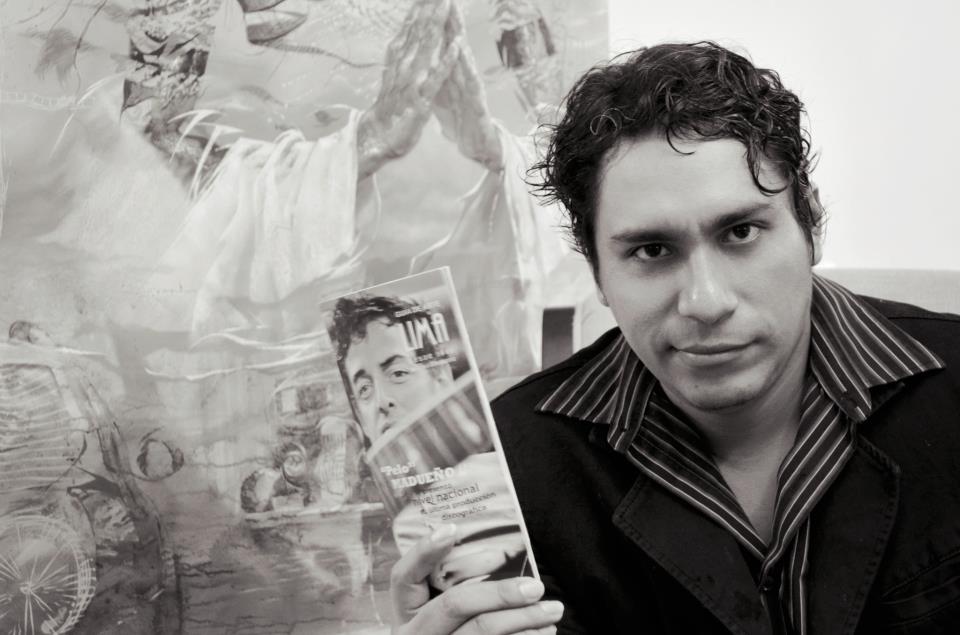
Portraits and moments from the studio offer a closer view of Poblet’s artistic practice and the world in which his work takes shape.
Education
Escuela Nacional Superior Autónoma de Bellas Artes del Perú
Lima, Peru
1997 graduating cohort
Selected career record
1997—2025
Escuela Nacional Superior Autónoma de Bellas Artes del Perú
Lima, Peru
Graduated with the 1997 cohort.
Museo de la Nación
Lima, Peru
Poblet exhibited at the Museo de la Nación in Lima in 1997.
Three dreams come true
One Brickell Square · Miami, United States
Group exhibition at One Brickell Square in Miami.
Humano y Urbano
Centro Cultural de Cali · Cali, Colombia
An oil-painting exhibition examining urban life, memory and the forces shaping contemporary experience.
Paradero de Vínculos
Museo Histórico Regional, Casa Garcilaso · Cusco, Peru
A painting exhibition in the museum’s temporary exhibition hall, reported in April 2012 with support from the regional cultural authority in Cusco.
BINARTECO — Bienal Internacional de Arte Ecológico
Lima, Peru
Listed among the selected artists for the 2014 edition of the ecological art biennial in Lima.
Plástica Palmirana 2 · Festival Ricardo Nieto
Palmira, Colombia
Programmed as the special guest of the collective exhibition Plástica Palmirana 2 on 24 June. On 26 June, Poblet also led the public conversation “El Artista y la Importancia de Retratar su Tiempo” within the festival’s academic programme.
ArtCali
Galería Arte Amérika · Cali, Colombia
Presented by Galería Arte Amérika at the 2015 ArtCali fair alongside artists from Colombia and abroad.
Cómics en Edición Limitada n. 7 — Ciencia Ficción
Galería Delbarrio · Lima, Peru
Listed by Galería Delbarrio among the participating artists in its science-fiction themed collective exhibition, held from 9 June to 31 July 2016.
ArtCali
Galería Arte Amérika · Cali, Colombia
Presented by Galería Arte Amérika at ArtCali 2016.
Singapore Contemporary
Galería Arte Amérika · Singapore
Represented by Galería Arte Amérika in the fair’s Latin American presentation; contemporary coverage highlighted an Untitled work by Poblet.
Expresiones
Centro Cultural UNFV · Lima, Peru
Group exhibition bringing together thirteen artists from the 1997 Fine Arts graduating cohort.
La cuadratura de la niebla
Sala Limaq, Museo Metropolitano de Lima · Lima, Peru
A painting exhibition centered on Latin American contemporary culture, urban space and ecological concern.
Wandering Deities
María Reiche Hall, Embassy of Peru · Berlin, Germany
A solo presentation exploring cultural identity through the coexistence of Andean and Western deities and contemporary symbols.
View exhibition →